Journal · October 25, 2026
The Carved Amethyst Eagle: Reading a Bird in Quartz
How do you find an eagle inside a rough crystal? The story of a carved amethyst eagle whose polished plumage rises from quartz left as it came.
Rough amethyst does not volunteer its subject. I look at a crystal for a long time — turning it toward the lamp and away, letting the natural faces suggest directions — and wait for something to step forward. Out of this piece of rough, what stepped forward had a beak.
That is how a gemstone bird carving begins here: not with a drawing, but with a long look. The carved amethyst eagle that finally came off the bench now stands in the Carvings collection, and this note is the record of how it was read — and of everything I chose to leave alone.
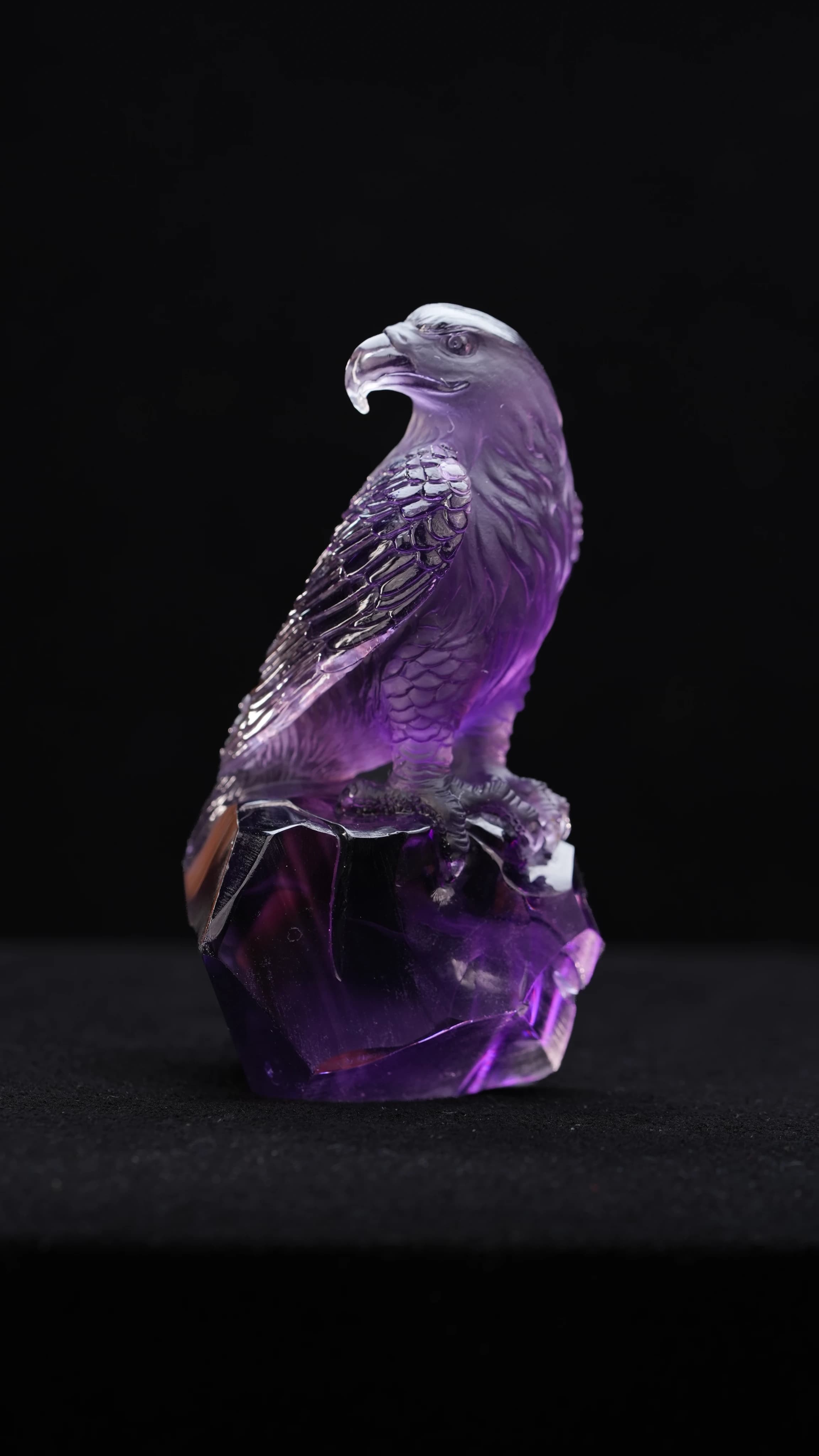
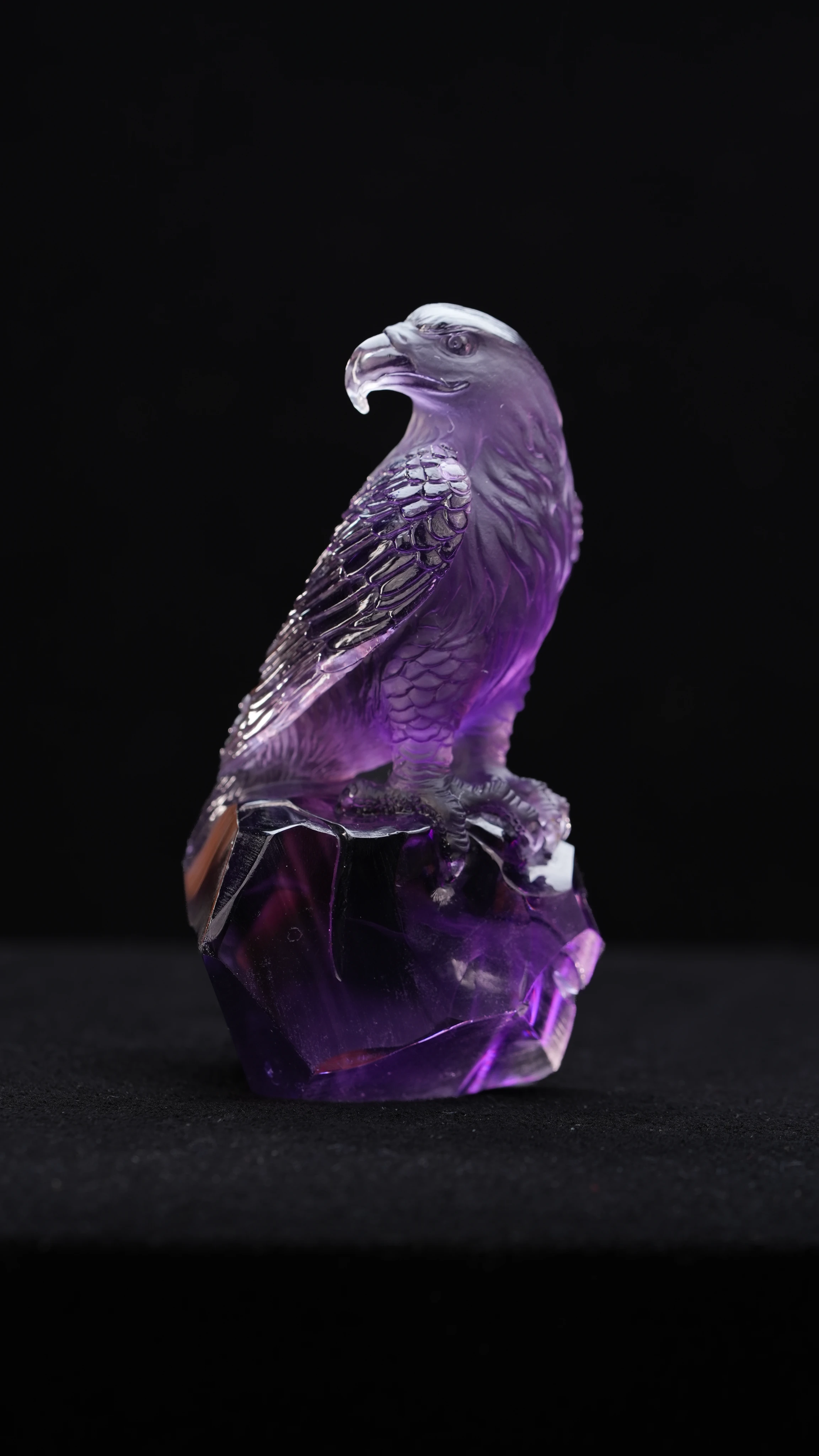
Seen whole, the piece divides cleanly in two: a worked bird above, raw crystal below.
Why amethyst asks to be carved
Amethyst is quartz — silicon dioxide — at hardness 7 on the Mohs scale: hard enough to hold a crisp carved edge, and commonly generous in rough sizes, which is why it has long been the classic carving quartz. Its colour comes from iron activated by natural irradiation, and it habitually zones in bands that parallel the crystal's rhombohedral faces.
Those bands are the carver's business. In this species the zoning is not a blemish to hide but a language to compose with: the classical task is to let bands of differing depth do the work of feather, ridge and shadow. So the first decision in any amethyst carving is not what to cut — it is where the bands may be allowed to lead the eye.
The species carries a long human familiarity, too. The Greeks named it amethystos, "the sober one", and cut drinking cups from it in the belief that it held off drunkenness; legend attaches the name to Dionysus and a maiden called Amethystos. From the Middle Ages it has served as the bishop's stone, and it still sits on episcopal rings today, with February as its birthstone month. An eagle carved from it claims none of that history by right. It simply carves inside the tradition.
Letting the beak lead
An eagle announces itself by parts, and the beak is the proof. That hooked downward curve is not a shape you can argue with; once I had found it in the rough, the orientation settled itself — head up, gaze outward, the body implied by the mass below. A gemstone bird carving lives or dies on this moment: the kind of bird is decided by which profile the stone can actually give.
At hardness 7 the stone does not yield so much as negotiate. Quartz meets the diamond burr with a small stubbornness of its own, so the plumage went in layered passes — the run of one feather line setting the next — and the eye was resolved with a single clean cut. A bird does not need every feather. It needs the sense of feathers all lying in one direction, and a head that reads as alert from across a room.
Polishing followed the quartz routine, cerium oxide on the bird and only on the bird. Hand carved amethyst keeps its honesty that way: every line was cut freehand, and no two passes are quite identical.
Where the carving stops
The bottom third of the stone is as it arrived: unpolished crystal, natural faces and irregular edges still carrying the record of how it grew. That base is the mount — there is no metal in this piece, nothing to string and nothing to set. The eagle stands on its own foundation, and it stands with confidence, because the raw mass below outweighs and steadies everything above it.
Stopping is a decision of the same weight as cutting. The border between bird and base runs where the crystal stopped offering directions; past that line, whatever I added would have been my invention rather than the stone's suggestion.
In the hand it measures 58.7 by 22.8 by 33.2 millimetres — just under six centimetres at its tallest — and weighs 40.13 grams. It feels like a small standing thing rather than a jewel: dense for its size, with the drag of unpolished crystal under the fingers and the smooth rise of the bird's neck above them.
A bird that cannot happen twice
One of a kind is a geometric fact here, not a slogan. This eagle exists because one particular piece of rough offered one particular beak. Cut the same design into a different crystal and the proportions would have to move — head smaller, neck thicker, base reshaped — until the result was a different bird altogether.
Freeform carving works this way by definition: the motif compromises with the stone, so the stone can never be swapped out from under it. And every feather line here was cut by hand — one bench, one pair of hands — so even I could not repeat the small tremor of each pass. That is what one of one actually means.
You can spend longer with the piece itself — the carved amethyst eagle has a page of its own. It belongs with the standing carvings rather than the worn ones: a shelf, a windowsill, a desk where it can hold its ground. And if you have a stone that might be hiding a bird, readings begin with a conversation — tell me what you see in it.