Journal · October 25, 2026
Carving Aquamarine: Two Bears from One Stone
A bench journal on carving aquamarine: why hardness and transparency set the order of the cuts, and how two bears were read out of a single piece of beryl.
Aquamarine is a beryl that sits between 7.5 and 8 on the Mohs scale — hard, but more usefully tough, with few of the fractures that make some gemstones nervous company under a wheel. It is also transparent. That pair of facts sets the terms of carving aquamarine: in an opaque stone a cut is simply a shape, while in a transparent one every passage of the tool rewrites the path light takes through the material, and a hollow cut deep enough will hold light rather than hand it back. Before the first cut, then, the work is already a question of order — what comes off first, what waits until the end, what must never be touched at all.
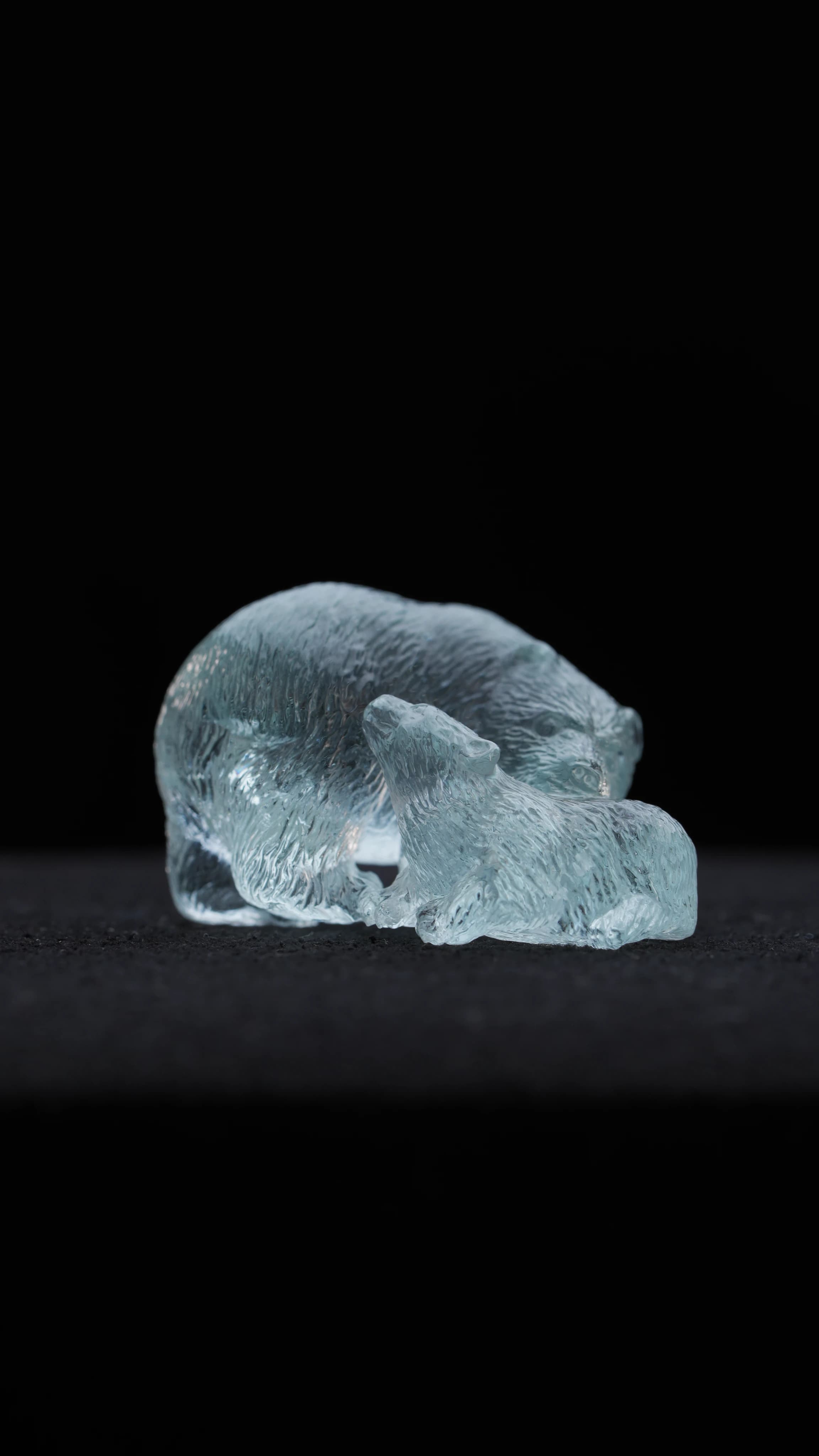
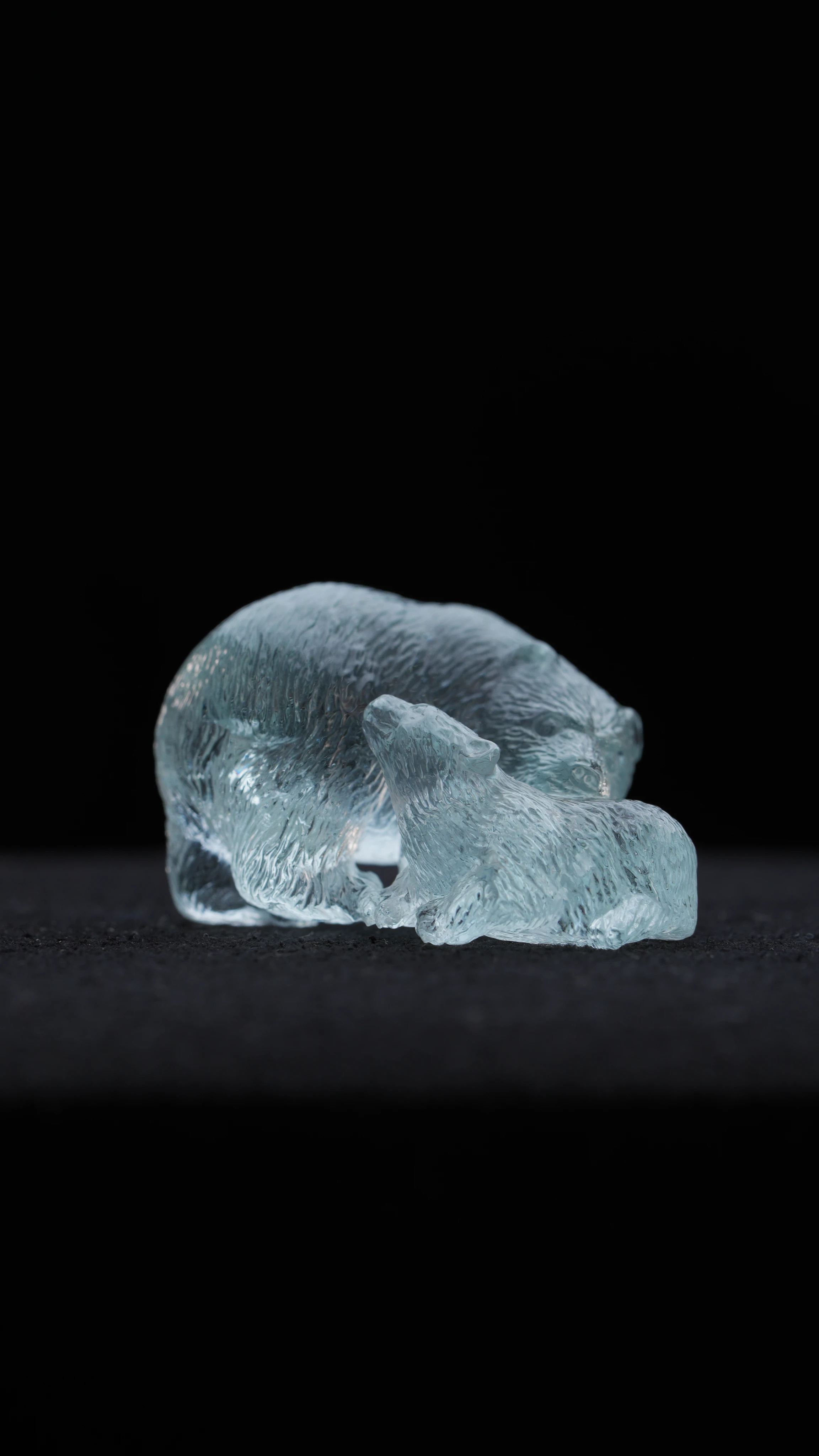
This journal follows that order through one piece: the Aquamarine Polar Bear, a mother curled round her cub, cut from a single piece of rough. It is a fair example of how gemstones are carved by hand at this bench — not a catalogue of equipment, but a chain of decisions in which every cut narrows the next.
How aquamarine behaves under the tool
Aquamarine is beryl — the same mineral family as emerald — at 7.5 to 8 on the Mohs scale, with good toughness and few internal fractures. That combination places it among the most carvable of precious stones. Its second defining fact is transparency: a cut in aquamarine works on light from inside the material, not just on its surface.
The name is older than the bears: aqua marina, Latin for sea water. Hardness governs speed at the wheel — a stone at 8 cannot be hurried, and pushing it buys nothing but heat, which is the one thing this species is asked to avoid. Toughness is the quieter virtue: aquamarine neither cleaves readily nor grows brittle under work, and clean rough comes large enough that a carver can think in the round — three dimensions, not a slab. One honest note for anyone who buys the species: most aquamarine in the trade has been gently heated to settle its colour from a greenish cast towards blue — a routine, stable practice, better stated than implied.
Reading what is already inside
Before any tool touches the rough, the stone is read. Inclusions, fracture lines and the shape of the mass decide which subjects can live in it; freeform carving — letting the motif follow the material — is less a style than a necessity. The reading comes first. Everything after it is taking away.
Aquamarine gives the reading a particular texture. The species can carry long parallel tubes — inclusions that run in families — and where they crowd closely enough, cutters shape them into cabochons that throw a cat's eye, chatoyancy being light gathered into one moving band. A carver meets those tubes the way a joiner meets grain: they suggest the direction the material would rather be worked.
This rough offered one dominant fact: a single large curve, generous enough to hold two animals. A mother curled round her cub is an argument carried entirely by that line — her back, shoulder and lifted head, turned to one side, making the outer wall, the cub nose-down against her flank and folded into the same circuit. Two heads from one stone, held together by one continuous curve. That was the reading; everything else was subtraction.
What the tools leave behind
Hand carving here moves from a preform trued on a sintered wheel, through shaping and hollowing with diamond burrs, to detail cut fine and finished against slurry. But the tools matter less than their residue: the surface, the hollow, the engraved line, the matte skin. Each mark is permanent, so each is chosen.
The engraved line is the oldest grammar in the glyptic arts — intaglio, the cut that sinks a design into stone rather than raising it, is as old as seals. Fur is where that grammar earns its keep on this group: lines drawn by burr, passing from one body into the other, the mother in long open strokes and the cub in close ones. Polish, meanwhile, is not the default estate of a carving. A polished skin speaks first and loudest; a matte skin lowers the voice and leaves the composition to carry the eye. On a transparent stone the choice between them is also a decision about light — returning it or keeping it — and this group was brought down to a matte finish so that the line, not the surface, would lead.
Which bear comes first
When two animals share one stone, the larger mass is roughed first and the smaller is found in whatever the first animal did not need. Surfaces precede lines; lines precede the finish. Reverse that order and the group loses its architecture — detail cut early is detail cut twice.
The mother is that architecture. Her curled mass is roughed first because everything else is found inside it — the wall the cub lies against, the axis set by her lifted, turned head. The cub comes second, cut from what she did not need: nose to flank, folded into her curve until the two read as one continuous form. Then the fur, engraved only after the surfaces are settled, tightest at the cub's crown, so the two animals read as two ages at a glance. Last of all, the base — a flat cut that lets the group stand on its own, with no metal to hold it and nowhere to hide. Carved gemstone animals live or die by this discipline: a group that begins with detail collapses into decoration.
When subtraction goes too far
Most difficulties in hard, transparent material are not dramatic breaks. They are cuts carried one line too far, or a passage hurried because the day was long. Aquamarine's toughness makes catastrophe rare; its hardness makes apology impossible — what is removed does not return.
An engraved line drawn wrongly cannot be erased. It can only be answered by the lines around it — deepened, crowded, folded into a rhythm that absorbs the error. And there are sittings that end with the tools put down earlier than pride would like, the stone left overnight and read again in the morning with a colder eye. That is not failure; it is the pace the material sets. The work stays slow, and not out of romance — beryl does not negotiate.
Finished, the whole group — mother, cub, both engraved coats, the flat base — weighs 9.36 grams, and it now sits among the other animals of the Carvings collection. It is, in the plain sense, one of a kind and entirely hand-carved: no second piece of rough will offer that curve, and the hand does not repeat itself either. As sculpture it stands on its own flat-cut base — unmounted, with nothing to hold it but the cut itself — though most of what leaves this bench does end up on the body. Either way the old line holds: carved in stone, worn as art. If a subject of your own is waiting inside a stone, I take commissions through the contact page.