Journal · October 25, 2026
Carved Pink Tourmaline: Reading a Crystal Before the Cat
Before a carver chooses a subject, tourmaline chooses a direction — pleochroism makes orientation the first decision, and that is how one leopard came to prowl on its own raw base.
Tourmaline is strongly pleochroic. Look down one axis of a crystal and it offers a certain colour; turn it ninety degrees and it offers another. For a lapidary this is not trivia — it is the first fact of the trade. Before a subject is chosen, before the first stroke of the preform, the carver must decide which way the finished piece will face the world, because the stone answers differently depending on the direction it is asked from. Every piece of carved pink tourmaline begins as a question of orientation.
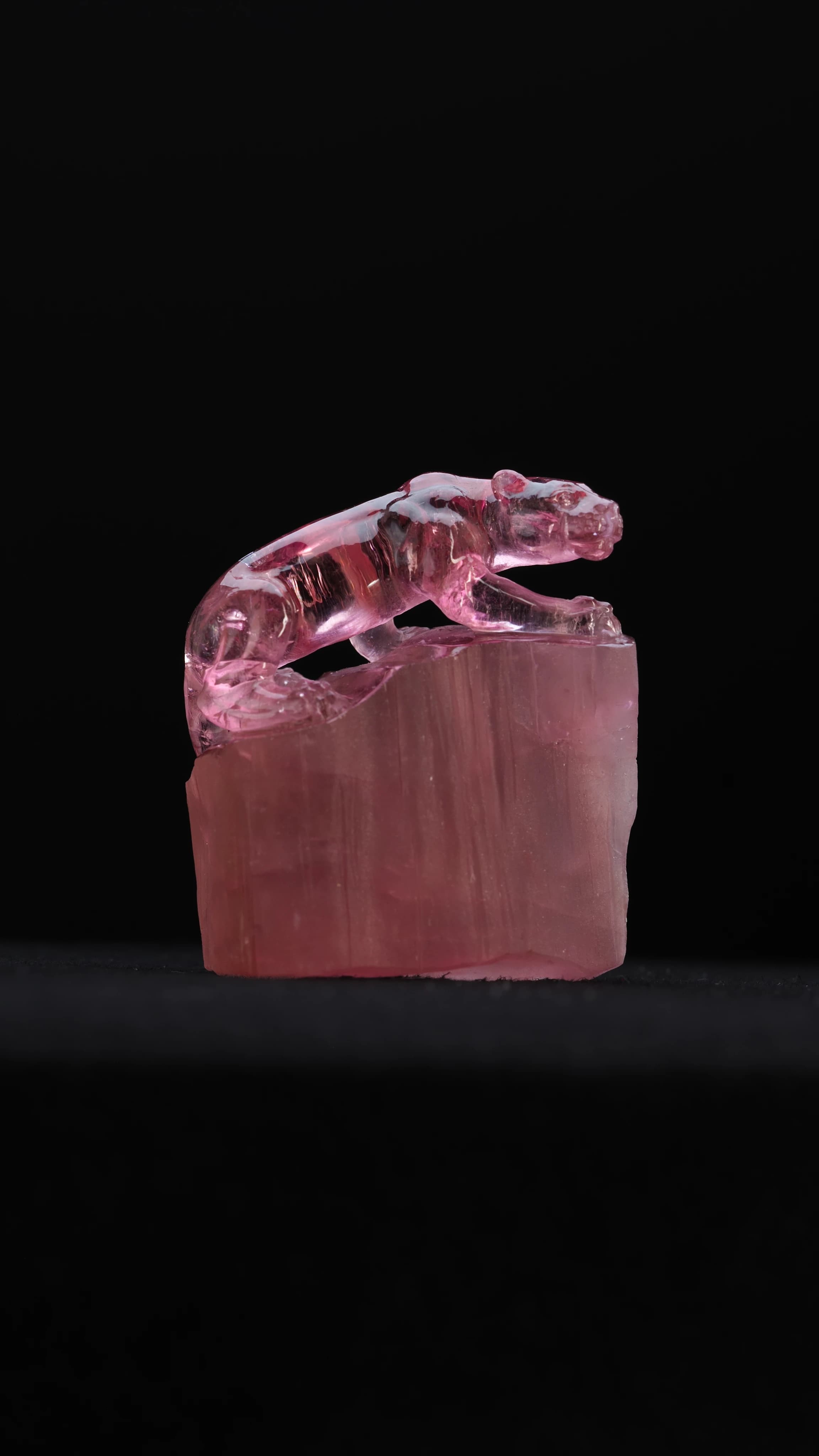
That question found its answer in the piece now in my palm: a leopard carved from the crown of a single tourmaline and left on its own raw base. The cat is mid-prowl, body stretched, head low — the patient walk of a hunter not yet seen. At 13.2 grams and 26 by 23.5 by 16.6 millimetres, it is a predator scaled to a closed hand.
What is pink tourmaline?
Pink tourmaline is the pink-to-peach range of elbaite, a complex borosilicate mineral and the gem heart of the tourmaline family. It rates 7 to 7.5 on the Mohs scale, takes a fine polish, and owes its name to the Sinhalese word turmali, once used loosely for coloured stones brought out of Sri Lanka.
The species carries a small electric temper. Warm a crystal or press it and its surfaces take on a charge strong enough to pull dust out of the air; eighteenth-century Dutch traders called the stone the aschentrekker — the ash-drawer — for exactly that habit. The same physics shapes its care: warm soapy water is enough, and sudden strong heat is best avoided, since it will leave the surface charged and gathering dust again.
Gem-quality rough comes chiefly from Mozambique, Minas Gerais in Brazil and Nigeria. A single crystal can hold more than one colour — the famous watermelon stones wear a green rind over a pink heart — and for most of history nobody was quite sure what to call any of it: the mineral travelled under borrowed names until science separated it as its own species in the eighteenth century. The Gemological Institute of America keeps the full mineral entry for anyone who wants the science at source.
Pink tourmaline meaning and lore
In modern crystal lore, pink tourmaline is the stone of love, compassion and the mending of hearts — a meaning far younger than the mineral that carries it. It is one of two October birthstones, sharing the month with opal, and it is the traditional stone of the eighth wedding anniversary.
The two October stones make odd neighbours. Opal is soft, amorphous, its colour a trick of packed silica spheres; tourmaline is hard, crystalline and faintly electric. A month that claims both offers its birthdays a choice between water and lightning.
Ask about pink tourmaline meaning and the honest answer has layers. The affectionate layer — love, compassion, an open heart — belongs to modern crystal lore, and I report it as lore: believed by many, owed to no laboratory. The older layer is simply the stone's history of mistaken identity, centuries of answering to other gems' names. And the layer I can speak to from the bench is neither of those; it is that a stone this directed, this particular about its axes, repays attention better than almost any material I cut.
Why tourmaline rewards a carver
Two properties make tourmaline a carver's stone. Its toughness holds fine detail — whiskers, toes, the ridge of a shoulder — where more brittle gems would crumble. And its strong pleochroism means the crystal shows a different colour along its length than across it, so every carving begins with orientation: choosing which axis the finished form will face.
Hardness is only half of that first sentence. Mohs 7 to 7.5 puts tourmaline among the harder gems, but what a carver actually asks for is toughness, and tourmaline has it: an edge cut into the stone stays an edge. The working sequence is ordinary and unhurried — big shapes on a sintered wheel, finer ones under diamond burrs, then slurry and patience for the polish — and none of it can be rushed. Pressure and heat both charge the crystal, drawing grit back onto the very surface being worked, so the bench discipline is written by the physics.
The real privilege of the species, though, is compositional. Because the axes answer differently, direction becomes design: a subject laid along the crystal's length will read one way, and the same subject turned across it will read another. The motif is never imposed on tourmaline; it is negotiated with the direction the crystal grew.
The species also has a long memory with the knife. In the late Qing court the Empress Dowager Cixi collected pink tourmaline so avidly that California's Himalaya mine shipped quantities of it across the Pacific, much of it as carved objects. It is no accident that animal carving jewellery has long kept company with carved pink tourmaline: the detail survives the burr, and the axis decides which way the animal shows itself.
The leopard at the bench
This leopard is Tourmaline Leopard, and like everything in the Carvings collection it began with reading rather than drawing. The rough offered a lying volume along its crown — long, low, tapering — and prowling is exactly the movement that lives in such a form. I did not so much choose the cat as admit it.
What I took away, I took from above: everything that was not cat. What I kept, I kept on purpose. The base stays exactly as it came out of the ground, so the animal stands on the same surfaces the mine saw, and the border between worked and unworked stone rests on an edge the mineral had already made. Polish and rough meet there; neither apologises.
Seen whole, the piece reads as one gesture — a cat stepping out of its own beginning.
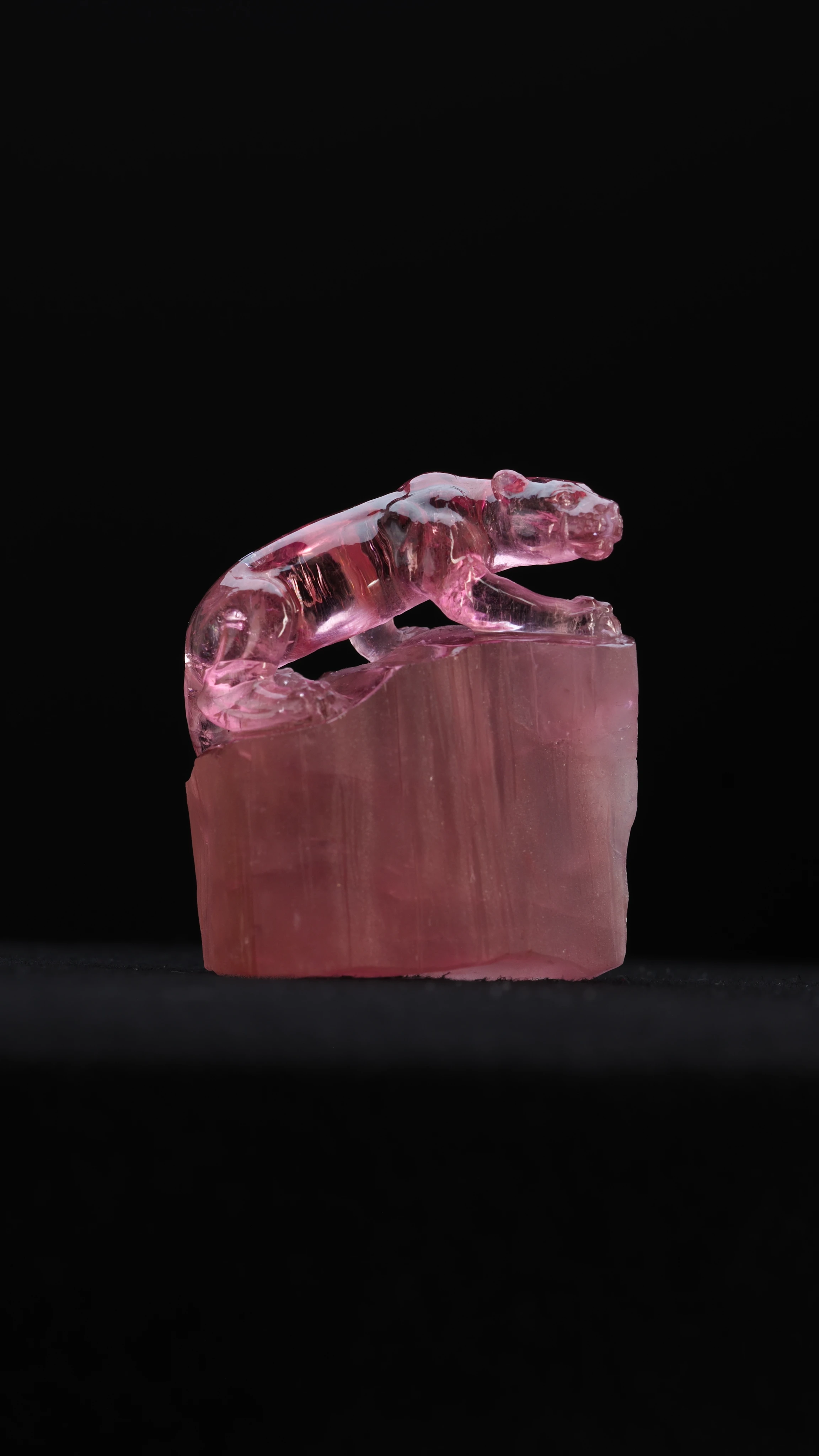
That double register — polished animal, untouched ground — is the whole argument of the piece in a single view.
There is no metal in it at all: no mounting, no glue, nothing between the palm and the stone. At 13.2 grams it has the heft of a walnut; at 26 by 23.5 by 16.6 millimetres it disappears inside a closed fist and reappears standing on a shelf, on the rough that grew it. Few things I make are this plainly themselves — hand-carved, polished, done.
And it is one of a kind in the plainest sense: the rough existed once, and its crown now walks. No second leopard can come off this crystal, which is arithmetic rather than boast.
Back to the first fact. A tourmaline answers the light differently along each of its directions, and every carving made from it must choose one. This one chose the long, low axis — the direction a prowling cat could believe in. If you keep a rough stone that seems to be waiting for its direction to be found, the bench takes those questions: start a conversation.