Journal · October 25, 2026
Hand Carved Citrine: A Fox Held in One Pebble
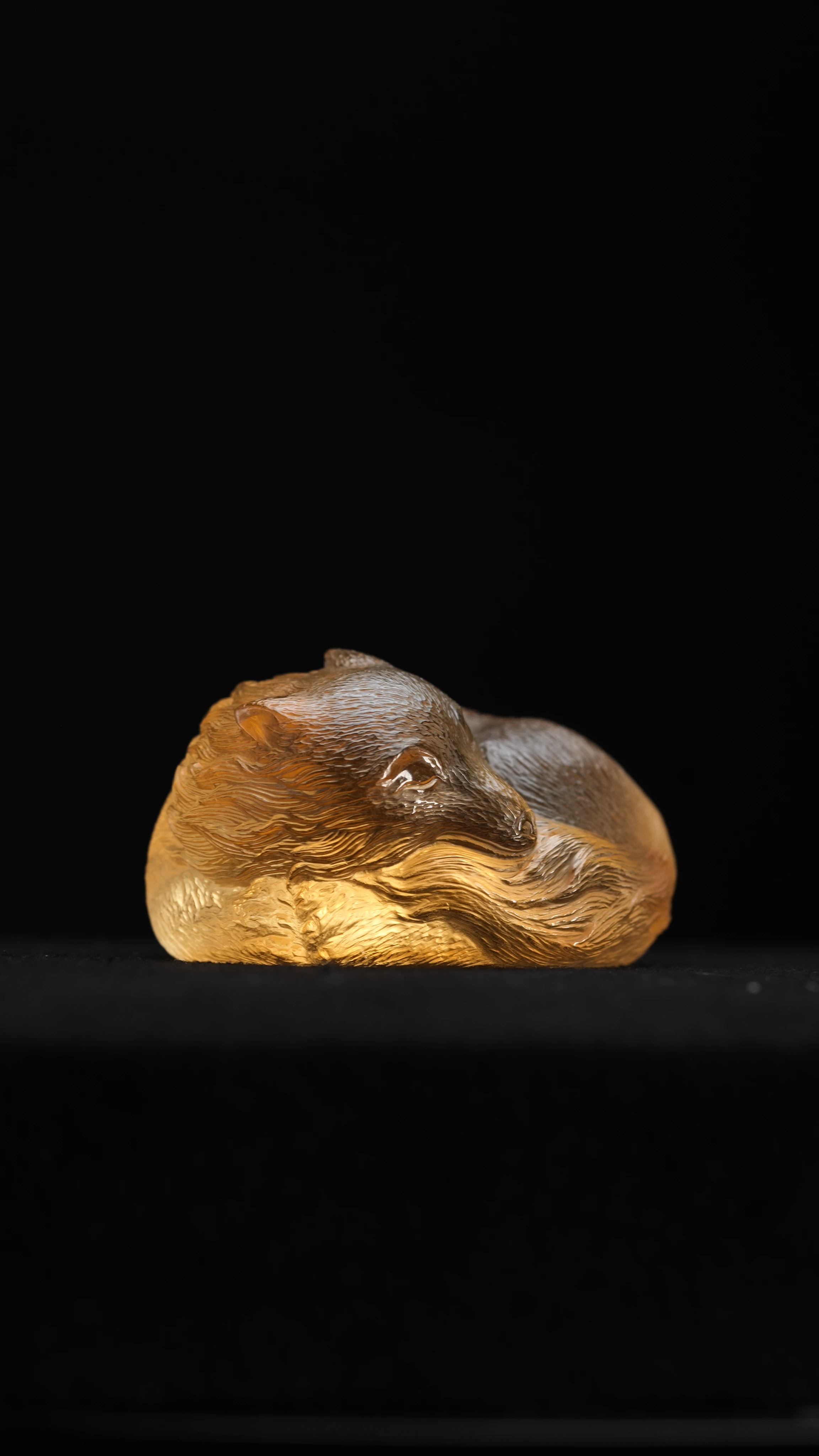
A fox asleep in one pebble of citrine: how the rough chose the curl, how diamond burrs cut fur into quartz, and why this sleeping shape could live in no other stone.
The dop cement goes on warm and sets hard within minutes, and for those minutes a pebble of rough citrine is neither stone nor sculpture — only a held thing, fixed to its stick under the bench lamp, waiting to be argued with.
That is how a hand carved citrine begins here: not with a fox, and not with a drawing, but with a length of rough persuaded to keep still until it stops being able to hide its shape. My work from that point is subtraction — to read what the pebble already holds and take away everything it does not need. What remained, this time, was an animal asleep.
The pebble decides the animal
Before any cutting begins, the rough is read: its shape, its flaws, its habits under the lamp. This is the discipline of freeform carving — the pebble's own outline chooses the subject. A curl that fits the rough survives; an idea imported against it does not.
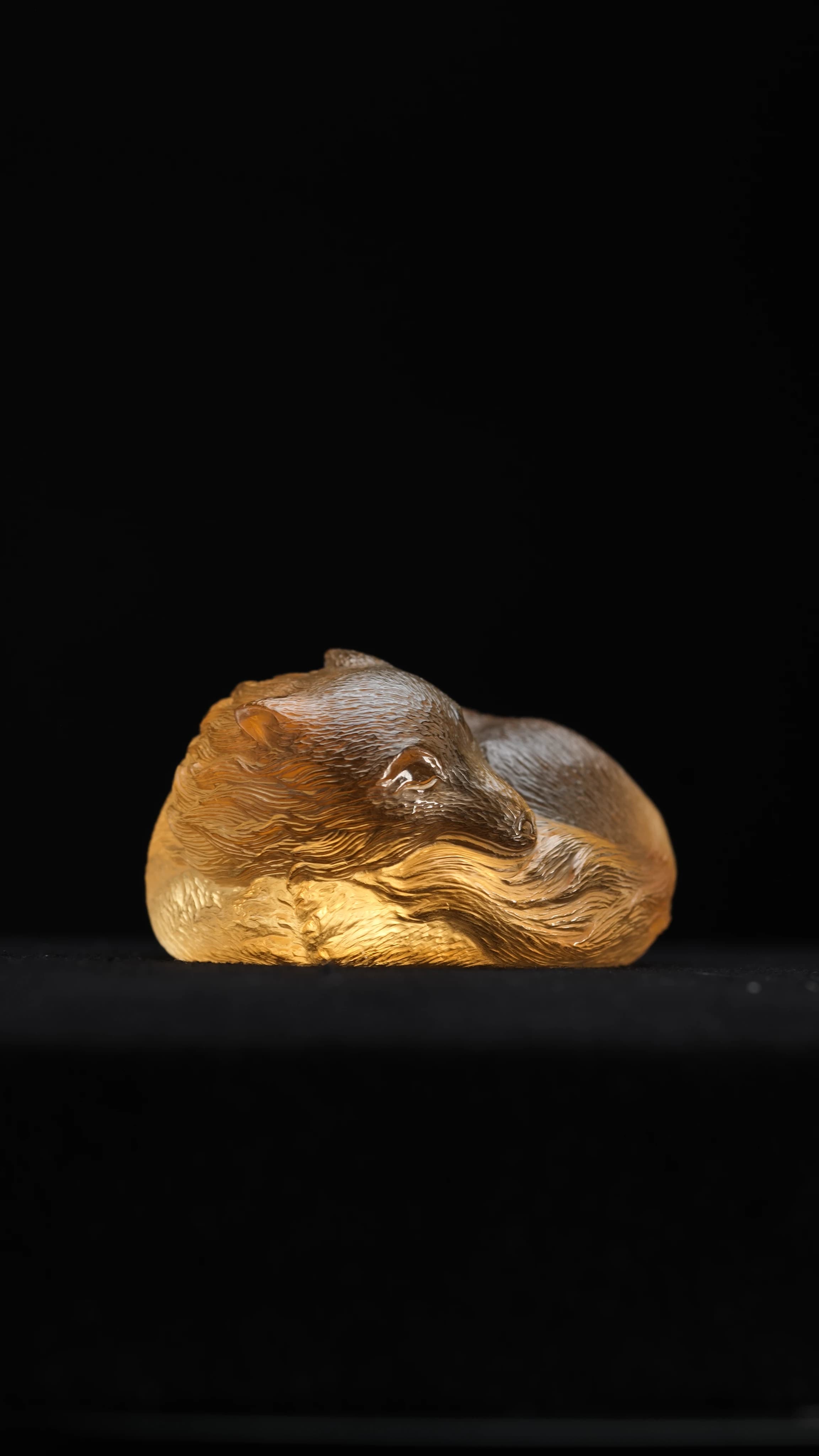
This rough was already a closed volume, a rounded pebble of a stone. A sleeping fox is the most compact form an animal can fold into: nose to tail, haunches tucked, the whole body one unbroken curve. The match was too plain to argue with. The tail could lie against the cheek because the stone already bent that way — the fox did not so much arrive as fall out of the pebble's own geometry.
Foxes declare themselves through very little: the muzzle, the ear, the tail. A closed eye is a single clean crescent, one decision. An open eye would be twenty decisions and a demand for symmetry the stone never promised. Sleep was the honest reading.
The finished piece keeps the pebble's word. In the Citrine Fox the curl is intact, the eye is one crescent, and the fur runs in waves that follow the body around.
Burr, wheel and slurry
The gem carving process for quartz runs through a short list of tools: a dop stick to hold the stone, diamond burrs to cut, a sintered wheel to smooth, and a final polish carried on tin or cerium oxide. Nothing in the kit is exotic. The judgement is.
Citrine is quartz — silicon dioxide at 7 on the Mohs scale — and quartz does not negotiate with steel. Every cutting edge in this process is diamond: burrs for the lines, a sintered wheel for the curves. Citrine carving shares its discipline with amethyst, its close relation among the carving quartzes: hardness that holds a crisp edge, toughness that lets a fine incision survive, rough in sizes generous enough to excuse a mistake. Those are the species' virtues. The fur on a sleeping fox leans on the last two.
One habit of the trade deserves saying plainly: most citrine on the market began as amethyst or smoky quartz, warmed by low heat into the yellow that named it — citron is French for lemon. The treatment is stable, routine and openly declared. At the bench it changes nothing about how the stone cuts or how it takes a polish.
From preform to incised fur
The order never changes: preform first, then the large curves, then the features, then incision, then polish. Mohs hardness sets the pace of every stage — quartz at 7 cuts slowly and takes a finish slowly, and a carver who hurries one stage pays for it in the next.
The preform came first: the pebble trued into a rough curl, everything that was not fox sawn and ground away while the volumes were still generous. Then the big curves — the dome of the back, the tuck of the haunch, the ledge where the tail sets against the cheek. Only when those arcs agreed with each other did the features arrive: the muzzle rounded, the ear set where the curl allowed it, the eye cut once as a crescent and left alone.
Then the fur, the stage that asks the most passes. Waves of incised lines follow the body around, each line cut into the surface with a fine burr, each ending before the surface it must not disturb. This is intaglio's instinct, older than any wheel I own: the line lives in the stone, not on it. On a sleeping animal the lines do the work shading does in a drawing — they say which way the body turns, where the tail crosses the flank, why the shape rests.
Last came the sitting surface: a flat cut and polished beneath the body, so the fox rests on its own base, unmounted — no metal anywhere, nothing between stone and shelf or stone and palm. Then the polish itself, riding a slurry of cerium oxide over the curves and staying off the incisions, because a line polished wide is a line lost.
Where the stone argues back
Every carving accumulates concessions. In quartz the usual ones are a line that chips where two cuts meet at a hard angle, and a polish that arrives slowly inside a deep concavity. The remedy is never force; it is a lighter tool, a slower pass, or a design that yields.
There are days the stone refuses. Quartz forgives much, but it has preferences: where incised lines cross, the material is at its thinnest, and a burr leaned on too eagerly takes a chip no polish can call back. Where a cut dives into a concave hollow, the polish arrives last of all, or not at all, until the tool is swapped for something smaller.
On those days the answer is not force. It is a lighter touch, a narrower burr, or a small surrender in the design — a line moved a hair's width, a wave of fur redirected around a stubborn patch. I have never finished a carving that matched its first intention. The second intention is always better, because the stone helped write it.
From the bench to an open palm
What the dop gave up at the end was small: a citrine fox of 21.72 grams, 32 by 27.8 by 18.6 millimetres, a curl that fits an open palm and sits by itself on a shelf. It is one of a kind not as a compliment but as arithmetic — the curl was read out of one pebble, and no second pebble repeats a first one.
Citrine keeps quiet company — November's birthstone, a merchant's talisman in crystal lore — and a sleeping fox does the same. The piece lives among the other Carvings, animals and figures each read from a single stone. If a curl of your own is what you are after, a subject your rough is already holding, write to me through the studio contact; reading a stone together is the first of the five steps between earth and hand, and none of them can be rushed.