Journal · October 25, 2026
Carved Emerald Octopus: Reading Arms from the Rough
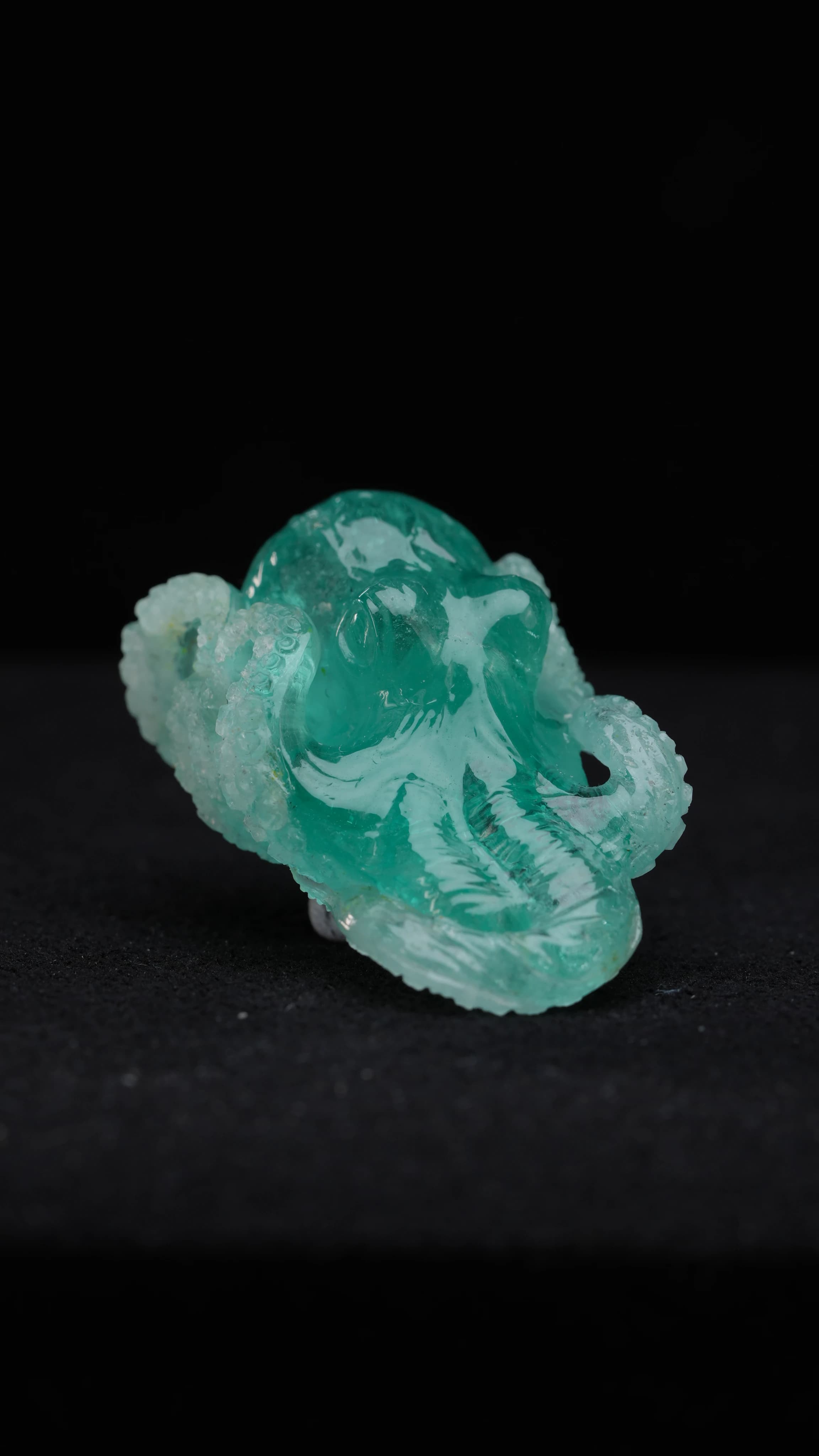
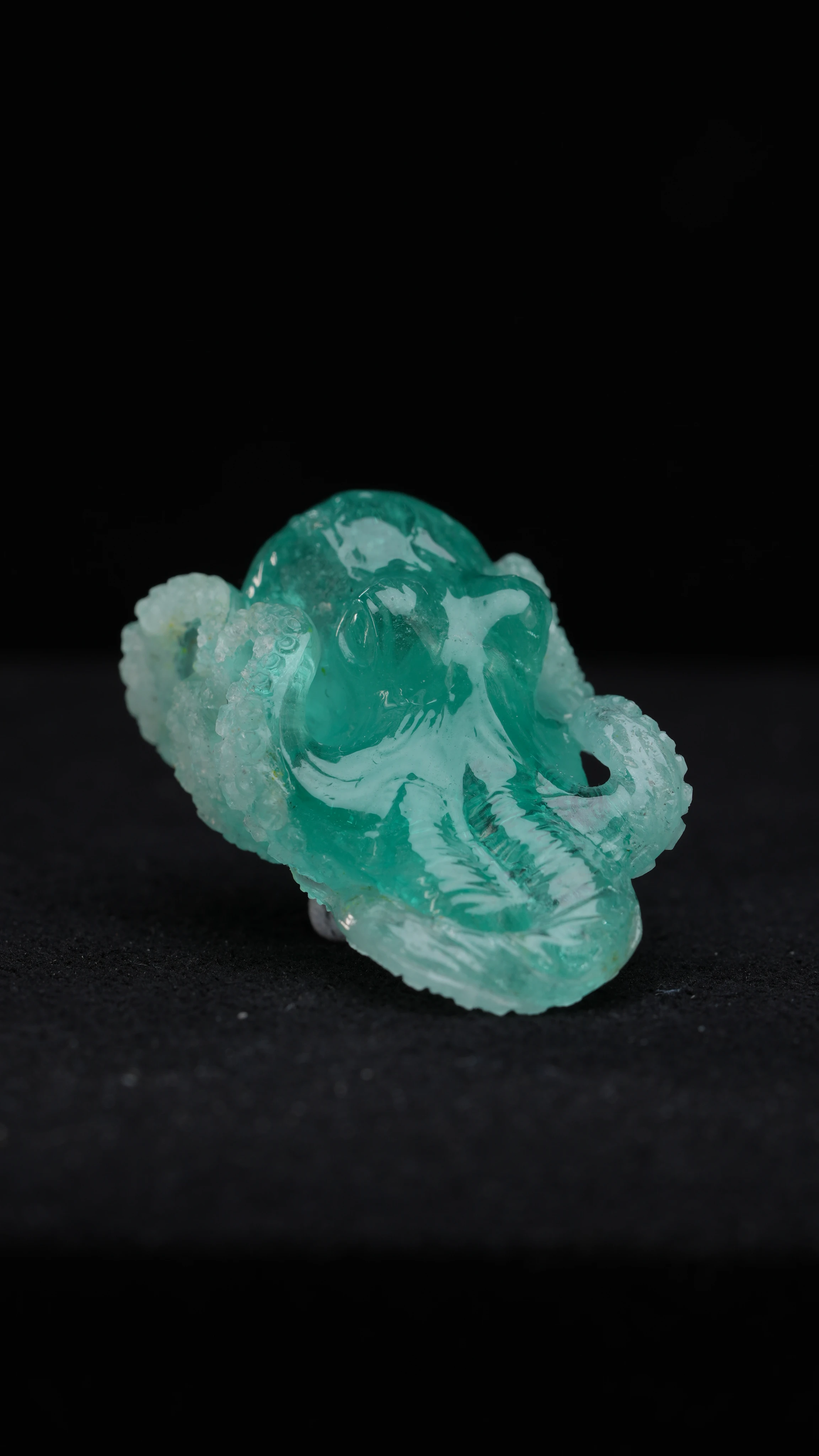
An emerald that would only accept one subject: eight arms read from a Nigerian rough, two of them coiled, the rest sweeping down to the surface the piece stands on.
The first decision at the bench was not how to carve this stone but whether it could be carved at all. Emerald will take a facet or a cabochon without complaint; a three-dimensional subject asks the crystal to lose mass in every direction at once, and emerald is famously unwilling. It is a brittle species, threaded with fissures and with the inclusions the French call the jardin, a garden — and a crystal with a garden inside splits along its own lines before it yields a shape. A carved emerald octopus is rare twice over: rare because clean emerald rough is rare, and rare because an octopus is one of the few subjects that can live with what emerald demands.
An octopus is nearly all curve. Eight arms that coil and sweep leave no long straight spans anywhere in the design, and in brittle material a curve is stronger than a span: stress runs back along the arm into the depth of the stone instead of crossing a thin bridge of it. That is why the subject was available to this rough at all. Anything with a neck, a limb held clear of the body, or a wing would have been an argument the stone could not win.
Can emerald be carved?
Yes, but rarely, and cautiously. Emerald is a beryl coloured green by chromium or vanadium, 7.5 to 8 on the Mohs scale, yet brittle rather than tough: the species almost always carries fissures and its jardin of inclusions, so cutters usually settle for a cabochon or a faceted stone. Full sculpture in emerald is uncommon, and every pass of the tool reads the fissure map first.
The name is older than the science: Latin smaragdus, from the Greek smaragdos, a word that served for green stones generally before mineralogy sorted them apart. The legends are older still — the stone of Venus, held to mark oaths, and Pliny's claim that gazing into emerald rested tired eyes. None of that helps at the bench. What helped here was simpler: a piece of Nigerian rough that stood up to the reading, and a subject whose anatomy ran in curves the whole way down.
Reading eight arms in the rough
I have never thought of carving as imposing. The work is closer to reading — finding the animal already arranged inside the crystal, then taking away everything it is not. In this rough the octopus was arranged vertically: mantle raised at the top, eight arms uncoiling from the crystal's own base below, exactly as the material had grown. Two arms closed into spirals where the rough allowed a coil; the rest sweep outward and down until they find the surface the piece rests on. Nothing in that spread was drafted first and forced onto the stone afterwards. The reach of the arms was read, and left as it grew.
Reading emerald is slower than reading most stones, because every line inside it is a potential parting line. I plan in curves, keep mass where the design runs thinnest, and stop when the stone says so. Many sittings go by between one safe pass and the next — that is the price of working a brittle crystal in three dimensions, and the rough sets the pace.
Standing without a setting
The Emerald Octopus is unmounted by design. It stands on its own coiled arms — the two spirals do the work of feet — with the remaining arms sweeping down to the same surface, and it sits upright unaided. It measures 32 by 19.8 by 13 millimetres and weighs 8.1 grams: a palm-scale object that closes inside a hand with room to spare.
A setting would have had to grip it somewhere, and every grip lands on an arm, interrupting a sweep the rough had already drawn. Left unmounted, the line of the animal runs from mantle to surface without a break. The head is polished smooth; the suckers run as fine raised rows along the arms, texture at arm's length and detail up close. As a hand carved emerald, it carries its technique in the open — cut and polished directly, with nothing between the rough and the finished animal.
The gesture of the piece holds in a single view: mantle lifted, arms uncoiling below it, the two spirals resting on the surface.
Why there cannot be a second
One of a kind is an easy phrase to print and a hard one to earn, so here is the arithmetic. The spread of the arms was not a pattern that could be scaled or repeated — it was read from one rough and left as it grew, and no two roughs grow alike. Every emerald carries its own fissure map, as individual as a fingerprint, which is why no two emerald carvings can share a plan. And the work was done by hand, by subtraction: there is no mould, no cast, no master file to run again. What the bench took away cannot be put back, and what it left cannot be re-found.
The Emerald Octopus has its own page, where the photographs do the describing. It keeps company with the other carved gemstone animals in the Carvings collection — each one read out of a different rough, none of them repeatable.
Emerald kept the terms of this piece. The subject was available because curves can live where straight lines cannot, and the spread of the arms belongs to one crystal only. That is the quiet satisfaction of the bench: reading what a rough already holds, and clearing away the rest, without asking the stone to become something it refused to be. If a subject has been reading you back — an animal, a stone, a shape that keeps returning — the bench is open, and commissions start from the rough, not from a list.